



SignaGel vs. Electrode Gel: What Is the Difference and Which Should You Use?
SignaGel® is an electrode gel. “Electrode gel” is the general product category, while SignaGel is a specific Parker Laboratories brand and formulation.
The distinction is similar to comparing a named product with the type of product it belongs to:
- Electrode gel describes an electrically conductive contact medium placed between intact skin and a compatible electrode.
- SignaGel is a multipurpose saline electrolyte gel within that category.
- Other electrode gels may be salt-free, adhesive, abrasive, cream-based, or designed for a narrower clinical application.
The real selection question is therefore not simply SignaGel or electrode gel.
It is:
Which type of electrode gel matches the procedure, electrode, patient-contact time and equipment instructions?
SignaGel is a highly conductive, water-soluble, non-staining, and non-gritty saline electrode gel recommended for ECG, defibrillation, biofeedback, and EMG procedures.
Shop SignaGel electrode gel from Balego, or browse our full collection of conductive gels, pastes, creams, and contact media.
SignaGel vs. Electrode Gel: Quick Answer
| Question | Answer |
|---|---|
| Is SignaGel an electrode gel? | Yes. SignaGel is a branded saline electrode gel. |
| Is every electrode gel SignaGel? | No. Electrode gel is a broad category containing several formulas and brands. |
| Is SignaGel salt-free? | No. Parker describes it as a saline electrolyte gel. |
| Is SignaGel adhesive? | No adhesive claim is made for SignaGel. |
| Can SignaGel be used for ECG? | Yes. ECG is one of its manufacturer-listed applications. |
| Can SignaGel be used for EMG? | Yes. EMG is one of its manufacturer-listed applications. |
| Can SignaGel be used for defibrillation? | Parker recommends it for defibrillation, subject to the equipment instructions. |
| Is SignaGel Parker’s preferred TENS gel? | Parker specifically identifies Spectra 360 for TENS and conductive rubber or carbon electrodes. |
| Is electrode gel the same as ultrasound gel? | No. Electrode gel transfers electrical current; ultrasound gel transmits acoustic energy. |
| Should gel be added to self-adhesive TENS pads? | Usually not. Pre-gelled hydrogel pads should be replaced when contact or gel condition deteriorates unless their instructions permit another procedure. |
What Is Electrode Gel?
Electrode gel is a conductive contact medium used to improve the electrical interface between intact skin and a compatible medical electrode.
Skin and electrode surfaces are not perfectly smooth. Microscopic gaps, dry areas, hair, oils, and uneven pressure can increase electrical resistance or interfere with signal quality. A suitable gel wets the contact area and helps create a more continuous conductive pathway.
Depending on the procedure, electrode gel may support the following:
- ECG or EKG signal acquisition
- Electromyography
- Biofeedback
- Patient monitoring
- TENS or compatible electrotherapy
- Conductive rubber or carbon electrodes
- Defibrillation when specifically permitted
- Other electromedical procedures identified by the gel and equipment manufacturers
Not every product described as a gel is intended to perform the same job. Conductive electrode gel, adhesive gel, skin-preparation gel, ultrasound transmission gel, and medical lubricating gel are separate product categories.
What Makes SignaGel Different?
SignaGel Electrode Gel is Parker Laboratories’ multipurpose saline electrolyte gel.
Its defining characteristics include the following:
| SignaGel feature | Product distinction |
|---|---|
| Formula category | Saline electrolyte electrode gel |
| Manufacturer-listed procedures | ECG, defibrillation, biofeedback and EMG |
| Conductivity | Highly conductive |
| Texture | Smooth and non-gritty |
| Cleanup | Water-soluble |
| Staining | Non-staining |
| Microbial-growth control | Bacteriostatic |
| Sterility | Nonsterile |
| Application surface | External use on intact, unbroken skin |
| Balego package | 60 g / 2 oz tube |
| Balego SKU | 15-60 |
The clear tube and stand-up cap make it easier to see the remaining product and store the tube upright between procedures. Current product information emphasizes broad electromedical versatility rather than long-wear TENS or adhesive performance.
The Most Important Comparison: SignaGel vs. Spectra 360
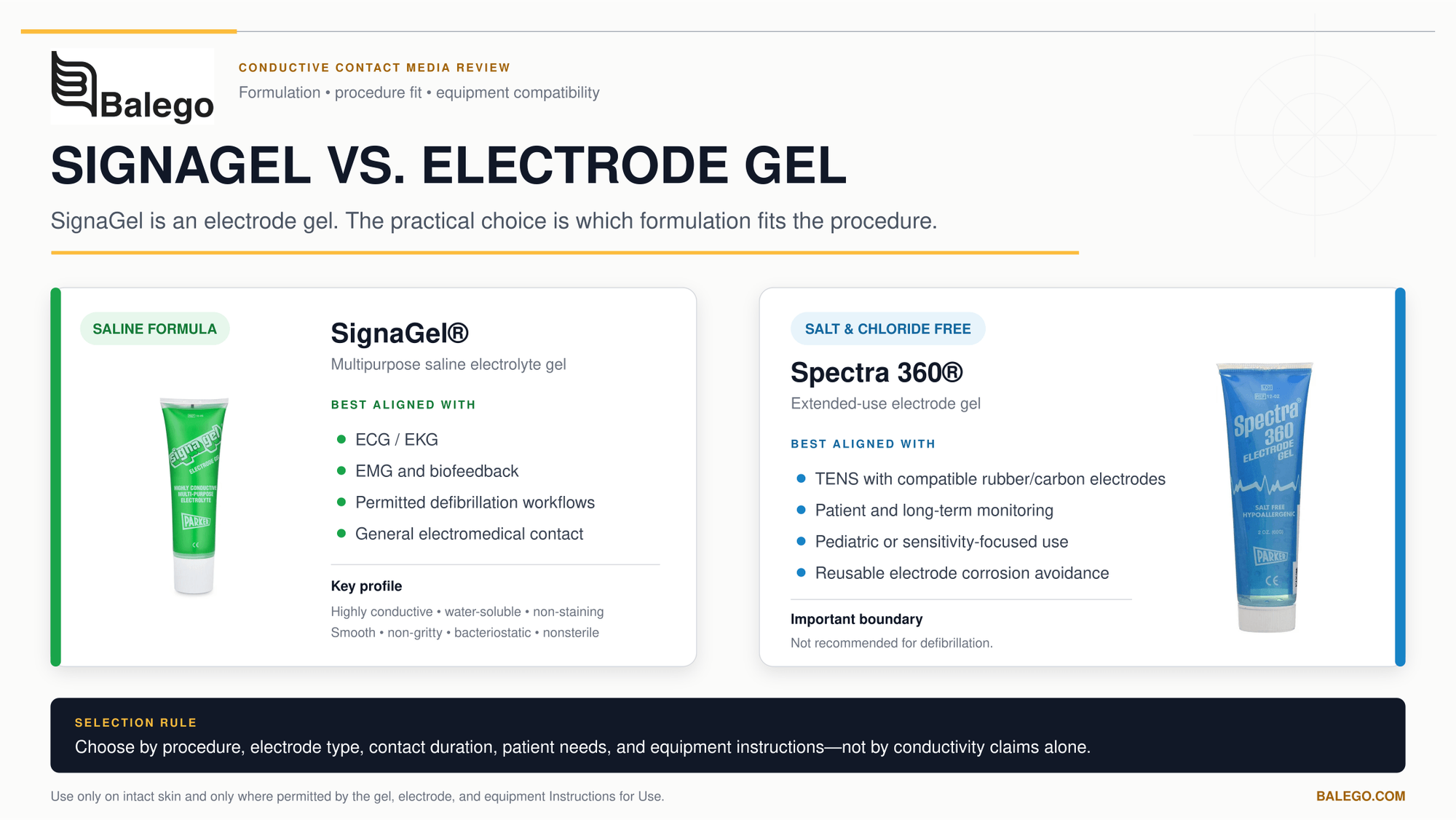
Many shoppers who search for “SignaGel vs. electrode gel” are actually trying to compare SignaGel with Spectra 360 Electrode Gel.
Both are conductive gels, but their formulas and primary applications differ.
| Feature | SignaGel | Spectra 360 |
|---|---|---|
| Product type | Multipurpose saline electrolyte gel | Salt-free and chloride-free electrode gel |
| ECG/EKG | Yes | Yes |
| EMG | Specifically recommended | Confirm equipment and electrode instructions |
| Biofeedback | Specifically recommended | Confirm equipment and electrode instructions |
| TENS | Not one of Parker’s highlighted applications | Specifically recommended |
| Patient monitoring | General electromedical use | Specifically recommended |
| Pediatric use | Not specially highlighted | Specifically recommended |
| Conductive rubber/carbon electrodes | Confirm electrode instructions | Specifically preferred |
| Defibrillation | Recommended when equipment permits | Not recommended |
| Long-duration contact | Multipurpose formula | STAY-WET® formula highlighted for extended use |
| Salt and chloride | Saline formula | Salt-free and chloride-free |
| Cleanup | Water-soluble | Water-soluble |
| Texture | Non-gritty | Non-gritty |
| Bacteriostatic | Yes | Yes |
Spectra 360 is its salt-free, chloride-free gel for ECG, TENS, patient monitoring, pediatric use, and conductive rubber or carbon electrodes. Its current instructions expressly exclude defibrillation.
Choose SignaGel when:
- ECG, EMG, or biofeedback is the primary procedure.
- The device instructions call for a saline electrolyte gel.
- Defibrillation compatibility is required, and the equipment permits a separate gel.
- A smooth, multipurpose clinical gel is preferred.
- Long-term salt avoidance is not a requirement.
Choose Spectra 360 when:
- The procedure is TENS using compatible reusable carbon or rubber electrodes.
- Extended monitoring is planned.
- A salt-free and chloride-free formula is preferred.
- The patient population includes pediatric or sensitivity-focused applications.
- Corrosion avoidance around reusable electrodes is an important consideration.
- Defibrillation is not part of the intended workflow.
Neither product should be selected solely because one sounds more “conductive.” The correct choice depends on the clinical procedure and equipment labeling.
SignaGel vs. Other Conductive Contact Media
SignaGel vs. Redux Electrolyte Gel
Redux Electrolyte Gel is another water-based conductive gel recommended for routine ECG and defibrillation.
| Feature | SignaGel | Redux Electrolyte Gel |
|---|---|---|
| Main positioning | Multipurpose saline electrode gel | Routine ECG and defibrillation gel |
| ECG | Yes | Yes |
| Defibrillation | Yes, when equipment permits | Yes, when equipment permits |
| EMG and biofeedback | Specifically identified | Not the primary manufacturer positioning |
| Formula | Saline electrolyte | Water-based electrolyte gel |
| Texture | Non-gritty | Non-abrasive and non-gritty |
| Cleanup | Water-soluble | Water-soluble |
| Balego package | 2 oz tube | 4 oz tube |
Choose SignaGel when a smaller multipurpose gel for ECG, EMG, biofeedback, and permitted defibrillation is useful. Choose Redux Gel when the workflow is centered on routine ECG and defibrillation and a larger tube is preferred.
SignaGel vs. Tensive Conductive Adhesive Gel
Tensive conductive adhesive gel performs two functions: conductivity and temporary electrode adhesion.
| Feature | SignaGel | Tensive |
|---|---|---|
| Conductive contact | Yes | Yes |
| Adhesive hold | Not its primary function | Yes |
| Tape replacement | No specific claim | Designed to reduce the need for tape |
| ECG | Compatible only as directed | Not its principal, highlighted use |
| EEG | Not its principal use | Yes |
| EMG | Yes | Yes |
| TENS | Confirm device instructions | Specifically identified |
| Defibrillation | Recommended when permitted | Not recommended |
| Cleanup | Water-soluble | Water-soluble |
| Texture | Fluid electrode gel | Adhesive gel |
Choose Tensive when a compatible reusable electrode needs temporary hold as well as conductivity. Choose SignaGel when adhesion is unnecessary and a multipurpose saline contact gel is required.
Tensive should not be substituted in a defibrillation workflow.
SignaGel vs. Ten20 Conductive Paste
Ten20 Conductive Paste is a thick conductive adhesive paste primarily used in neurodiagnostic procedures.
| Feature | SignaGel | Ten20 |
|---|---|---|
| Consistency | Smooth gel | Thick adhesive paste |
| Main procedures | ECG, defibrillation, EMG, and biofeedback | EEG, evoked potentials, PSG, and related neurodiagnostics |
| Electrode hold | Limited | Stronger adhesive function |
| Best with | Compatible electromedical electrodes | Compatible non-gelled cup or neurodiagnostic electrodes |
| Defibrillation positioning | Yes, when permitted | Not positioned for defibrillation |
| Extended electrode placement | General gel | Designed to help maintain long-duration attachment |
Ten20 is not simply “stronger SignaGel.” It is designed for a different workflow in which electrode retention is a central requirement.
For a dedicated comparison of neurodiagnostic preparation and attachment products, read Ten20 vs. NuPrep: Differences, Uses, and Electrode Prep.
SignaGel vs. NuPrep Skin Prep Gel
NuPrep Skin Prep Gel is not a substitute for SignaGel.
NuPrep is a mild abrasive preparation product used before electrode application to remove surface oils and dead skin cells and help reduce skin impedance. SignaGel is a conductive contact medium used at the electrode-to-skin interface.
| Workflow stage | Appropriate product |
|---|---|
| Prepare and mildly abrade the skin | NuPrep |
| Provide conductive electrical contact | SignaGel or another compatible contact medium |
| Help hold a neurodiagnostic electrode | Ten20 or another approved adhesive medium |
| Improve contact beneath compatible reusable TENS electrodes | Spectra 360 when permitted |
| Transmit therapeutic ultrasound | Ultrasound transmission gel |
Use only the preparation products and methods permitted by the procedure, electrode, and device instructions. Over-preparation can irritate the skin.
Is SignaGel the Same as Ultrasound Gel?
No.
Although electrode gel and ultrasound gel may look similar, they are optimized for different forms of energy.
| Contact medium | Designed to transmit |
|---|---|
| SignaGel or electrode gel | Electrical current or bioelectric signals |
| Ultrasound transmission gel | Acoustic ultrasound energy |
| Conductive adhesive gel | Electrical current plus temporary electrode hold |
| Medical lubricating gel | Mechanical lubrication |
| Skin-preparation gel | Prepares the skin before electrode placement |
Aquasonic 100, for example, is formulated to be acoustically correct across medical ultrasound frequencies. SignaGel is formulated as an electrically conductive electrolyte for electromedical procedures.
Do not assume that any water-based medical gel can replace another. Use the contact medium identified by the device or transducer manufacturer.
Can SignaGel Be Used with TENS?
Do not treat “electrode gel” as automatically interchangeable with every TENS setup.
Recommends Spectra 360 for TENS and conductive rubber or carbon electrodes. TENS is not among the primary procedures highlighted on the current SignaGel product information.
SignaGel may be suitable only when:
- The TENS device manufacturer permits it.
- The reusable electrode manufacturer permits a saline electrode gel.
- The selected electrode requires a separate contact medium.
- The product is applied to intact skin.
- The clinician follows all applicable instructions.
What about self-adhesive TENS pads?
Most reusable self-adhesive pads already contain conductive hydrogel. They normally do not require a separately applied tube of electrode gel.
Replace the pads when:
- Adhesion declines.
- The hydrogel dries or becomes contaminated.
- Pad edges repeatedly lift.
- Stimulation becomes sharp or uneven.
- The conductive surface is damaged.
- The connector becomes unreliable.
Unless the electrode manufacturer expressly permits it, adding SignaGel, water, or another liquid is not the preferred way to restore a worn self-adhesive pad. Balego’s electrode guidance recommends replacing pads when gel condition, adhesion, or current delivery deteriorates.
Compare replacement options in our electrotherapy electrode collection or shop Balego reusable TENS, NMES, and FES electrodes.
Can SignaGel Be Used for Defibrillation?
Parker recommends SignaGel for defibrillation, but that statement does not mean gel should be added to every defibrillator or adhesive pad.
Use SignaGel for defibrillation only when
- The defibrillator manufacturer permits or requires separate electrode gel.
- The paddle or electrode system is designed for gel use.
- The current equipment Instructions for Use are followed.
- The gel is applied in the amount and location specified by the equipment manufacturer.
- The product has not been contaminated or damaged.
Do not substitute Spectra 360 or Tensive for defibrillation. Their manufacturers specifically state that they are not recommended for that procedure.
For routine ECG and permitted defibrillation workflows, we also offer Redux Electrolyte Gel.
Conductive Gel Selection Guide
| Procedure or requirement | Product to consider | Main reason |
|---|---|---|
| ECG, EMG, and biofeedback | SignaGel | Multipurpose saline conductive gel |
| Permitted defibrillation workflow | SignaGel or Redux Gel | Manufacturer-listed defibrillation use |
| TENS with compatible rubber or carbon electrodes | Spectra 360 | Salt-free gel specifically positioned for TENS |
| Long-term monitoring | Spectra 360 | STAY-WET formula and salt-free design |
| Electrode conductivity plus temporary adhesion | Tensive | Adhesive conductive gel |
| EEG, PSG, and extended neurodiagnostic attachment | Ten20 Conductive Paste | Thick conductive adhesive paste |
| Lower skin impedance before diagnostic electrode placement | NuPrep | Mild abrasive skin preparation |
| Routine ECG with a cream texture | Redux Electrolyte Creme | Cosmetic-quality conductive cream |
| Therapeutic or diagnostic ultrasound | Ultrasound transmission gel | Acoustic rather than electrical coupling |
| Self-adhesive TENS/NMES pads | Pre-gelled replacement electrodes | Separate tube gel usually unnecessary |
How to Use SignaGel
The correct application method depends on the electromedical equipment and electrode.
A general workflow is the following:
- Confirm that SignaGel is approved for the intended procedure.
- Review the equipment and electrode Instructions for Use.
- Inspect the skin and use the gel only on intact, unbroken skin.
- Prepare the site according to the procedure and facility protocol.
- Apply only enough gel to create the required contact layer.
- Keep the tube tip from touching the patient, electrode, staff, or instruments.
- Position the compatible electrode or paddle according to its instructions.
- Confirm acceptable signal quality or electrical contact.
- Complete the procedure.
- Remove remaining gel using a soft cloth moistened with water.
- Close the container promptly after use.
- Store the product away from direct sunlight.
The SignaGel IFU states that the product is nonsterile, intended for external use on intact skin and water-soluble. It also instructs users to prevent the dispensing tip from contacting patients, personnel, or instruments to reduce contamination risk.
How Much SignaGel Should Be Applied?
There is no one universal volume for every electrode and procedure.
Use the minimum amount needed to create the contact interface specified by the equipment manufacturer. Excessive gel can:
- Spread beyond the intended electrode area.
- Create a mess around diagnostic leads.
- Interfere with adhesive materials.
- Transfer between nearby electrodes.
- Contaminate equipment or linens.
- Make consistent placement more difficult.
Too little gel may leave dry gaps or incomplete contact.
Follow the equipment instructions rather than using a fixed teaspoon, bead length, or layer thickness copied from another procedure.
SignaGel Cleanup and Storage
SignaGel is water-soluble, non-staining, and non-gritty. Parker instructs users to remove it with a soft cloth moistened with water.
Cleanup checklist
- Wipe the skin gently rather than scrubbing.
- Follow the equipment manufacturer’s cleaning procedure.
- Do not immerse reusable electrodes or cables unless expressly permitted.
- Remove gel before it dries around connectors.
- Inspect the skin for irritation.
- Dispose of contaminated single-use materials according to facility policy.
Storage checklist
- Close the cap after use.
- Protect the tube from direct sunlight.
- Keep the dispensing tip clean.
- Do not use a damaged container.
- Discard the product if contamination is suspected.
- Follow the printed expiration date.
- Do not transfer gel into an unlabeled container.
SignaGel Safety Considerations
The current instructions identify several important precautions:
- Use externally on intact, unbroken skin.
- Do not use the product when the container is damaged or contaminated.
- Avoid contact between the tube tip and the patient, personnel, or instruments.
- Do not use in patients with a known history of skin allergy to parabens.
- Follow the Instructions for Use supplied with the electromedical device.
- Report serious product-related incidents through the appropriate channels.
Stop the procedure and assess the skin when there is burning, marked redness, swelling, rash, hives, or another unexpected reaction.
Frequently Asked Questions
Is SignaGel just a generic electrode gel?
No. It is a registered tradename with a specific saline electrolyte formulation and defined manufacturer-listed applications.
Is “Signa Gel” the same as SignaGel?
Yes. “Signa Gel” is a common search spelling, but the registered product name is SignaGel®.
Is electrode gel the same as conductive gel?
The phrases are often used interchangeably when discussing electrical contact media. However, “conductive gel” can also describe ultrasound gel, adhesive gel, and other specialized products, so the intended energy type and procedure must be confirmed.
Is SignaGel saline-based?
Parker describes SignaGel as a multipurpose saline electrode gel.
Is SignaGel salt-free?
No. Choose Spectra 360 when a salt-free and chloride-free electrode gel is required.
Is SignaGel adhesive?
SignaGel is not marketed as an adhesive gel. Choose Tensive when both conductivity and temporary electrode hold are needed.
Can SignaGel be used for ECG?
Yes. ECG is among Parker’s listed applications.
Can SignaGel be used for EKG?
Yes. ECG and EKG refer to the same cardiac electrical-recording procedure.
Can SignaGel be used for EMG?
Yes. EMG is one of its listed uses.
Can SignaGel be used for EEG?
SignaGel is not Parker’s principal adhesive product for EEG. Tensive or Ten20 may be more appropriate depending on the electrode type, examination duration, and facility protocol.
Can SignaGel be used for TENS?
Only when the TENS device and electrode instructions permit it. Parker specifically recommends Spectra 360 for TENS and reusable conductive rubber or carbon electrodes.
Can SignaGel be added to worn TENS pads?
Do not assume that it can restore self-adhesive hydrogel pads. Replace pads when adhesion, hydrogel condition, or current distribution deteriorates unless their manufacturer provides another approved procedure.
Is SignaGel safe for defibrillation?
Parker recommends it for defibrillation. It should only be used with equipment designed to accept a separate conductive gel and according to the equipment instructions.
Is Spectra 360 safe for defibrillation?
No. Parker specifically states that Spectra 360 is not recommended for defibrillation.
Is Tensive safe for defibrillation?
No. Parker specifically states that Tensive is not recommended for defibrillation.
Can ultrasound gel replace SignaGel?
Do not make that substitution unless both equipment manufacturers expressly permit it. Ultrasound gel is designed for acoustic transmission, while SignaGel is designed for electrical contact.
Can medical lubricating gel be used as electrode gel?
No universal substitution should be made. Medical lubricant is formulated for lubrication rather than verified electromedical conductivity.
Is SignaGel sterile?
No. SignaGel is a nonsterile product.
Can SignaGel be used on an open wound?
No. Its Instructions for Use specify external use on intact, unbroken skin.
Does SignaGel stain clothing?
Parker describes the product as non-staining, but prompt cleanup remains advisable.
How is SignaGel removed?
Use a soft cloth moistened with water and follow the equipment-cleaning instructions.
Does SignaGel expire?
Use the printed expiration date and discard any tube that is damaged or appears contaminated.
Can the tube tip touch the electrode?
The manufacturer instructs users to avoid contact between the dispensing tip and patients, personnel, or instruments. Dispense the product without touching the clinical surface.
Key Takeaway
SignaGel is not an alternative to electrode gel—it is one specific type of electrode gel.
Choose it when the procedure calls for a smooth, saline, multipurpose conductive medium for:
- ECG or EKG
- EMG
- Biofeedback
- Defibrillation when the equipment permits a separate gel
Choose another product when the workflow has a different requirement:
- Spectra 360: salt-free TENS, monitoring, pediatrics or conductive rubber/carbon electrodes
- Redux Gel: routine ECG and permitted defibrillation
- Tensive: electrical conductivity plus temporary adhesion
- Ten20: neurodiagnostic electrode attachment
- NuPrep: skin preparation rather than conductive contact
- Ultrasound gel: acoustic coupling
- Pre-gelled hydrogel pads: ordinary portable TENS and NMES setups
The gel label, electrode instructions, and device manual—not the generic word “conductive”—should determine the correct contact medium.
Shop SignaGel Electrode Gel, compare Spectra 360 Electrode Gel, or explore our Conductive Gel and Contact Media Guide.


